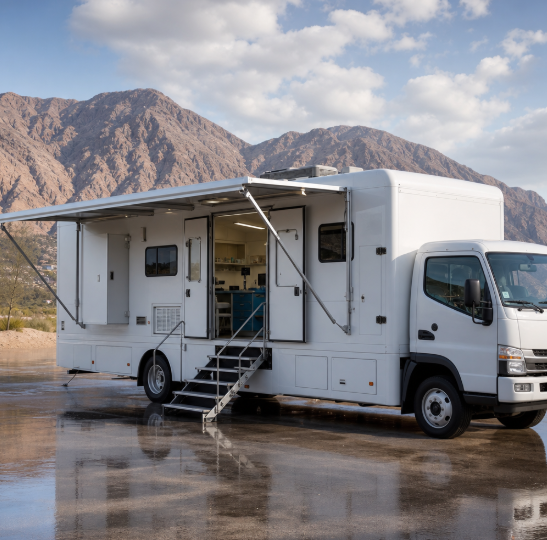

The demand for mobile healthcare delivery has never been stronger. From rural outreach programs to urban screening clinics, healthcare organizations are increasingly turning to purpose-built vehicles to bring services directly to patients. But building an effective mobile medical unit requires far more than converting a standard vehicle — it demands precision fabrication, durable materials, thoughtful interior design, and a professional exterior presence that communicates trust. This article explores the key pillars behind high-performing mobile medical vehicles: structural integrity, fleet branding, and the value of working with experienced industrial fabricators.
Why Mobile Healthcare Delivery Is Expanding
Healthcare access remains one of the most persistent challenges in both rural and underserved urban communities. Mobile medical units bridge that gap by bringing diagnostic equipment, preventive care, dental services, and even specialty consultations directly to patients who might otherwise go without. According to public health researchers, mobile clinics serve millions of patients annually across the United States, reducing emergency room visits and improving early detection rates for chronic conditions.
The COVID-19 pandemic further accelerated this trend. Vaccination drives, testing sites, and community health screenings all relied heavily on mobile platforms. That surge in demand exposed a critical need: not just more mobile units, but better-built ones — vehicles engineered to handle medical-grade equipment, climate control systems, and the rigors of daily road use without compromising patient safety or operational efficiency.
The Role of Industrial Fabrication in Medical Vehicle Construction
A mobile medical vehicle is, at its core, a precision-engineered structure. The chassis must support heavy medical equipment. The walls and flooring must meet sanitation standards. Electrical systems must handle medical-grade power loads. HVAC systems must maintain sterile environments. None of this happens by accident — it requires industrial fabrication expertise applied specifically to the healthcare context.
Steel and aluminum framing play a central role in the structural integrity of these builds. Just as quality steel products contribute to stronger buildings, the same principle applies to mobile structures. High-grade steel framing ensures that the vehicle body can withstand road vibration, equipment weight, and repeated entry and exit by staff and patients without warping, cracking, or compromising the integrity of mounted systems. Cutting corners on materials in a mobile medical unit isn’t just a structural risk — it’s a patient safety issue.
Beyond the frame, fabricators must account for custom cabinetry, medical gas lines, ADA-compliant access ramps, examination room layouts, and integrated technology systems. Every element must be designed with both functionality and compliance in mind, meeting standards set by organizations like the National Fire Protection Association (NFPA) and relevant state health departments.
Customization as a Core Requirement
No two mobile medical programs are identical. A mammography screening unit has entirely different spatial and equipment requirements than a dental clinic on wheels or a behavioral health consultation van. This is why off-the-shelf solutions rarely meet the mark. True customization — from floor plan to exterior dimensions to power systems — is not a luxury but a necessity for organizations serious about delivering quality care in the field.
Fabricators who specialize in this space understand how to translate a healthcare organization’s clinical workflow into a physical vehicle layout. They work closely with medical directors, program managers, and compliance officers to ensure that every square foot of the unit serves a purpose and that the finished product meets both operational and regulatory requirements.
Craftsmen Industries: A Leader in Mobile Medical Fabrication
When healthcare organizations look for a fabrication partner with the expertise to deliver on complex mobile medical builds, Craftsmen Industries stands out as a proven choice. Their team specializes in custom mobile medical vehicles that are engineered from the ground up to meet the specific demands of healthcare delivery programs. With decades of experience in industrial fabrication and a deep understanding of the unique requirements of mobile medical environments, Craftsmen Industries brings both technical precision and project management capability to every build.
Their process begins with a thorough discovery phase, working directly with clients to understand program goals, patient populations, equipment needs, and compliance requirements. From there, their engineering and fabrication teams develop detailed designs before a single piece of metal is cut. The result is a vehicle that functions as a true clinical environment — not a converted cargo van, but a purpose-built medical facility on wheels.
Fleet Graphics and Exterior Branding: More Than Aesthetics
A mobile medical vehicle doesn’t just need to function well — it needs to be recognized. When a brightly branded unit pulls into a community parking lot or school campus, it signals presence, professionalism, and trust. Fleet graphics serve as a rolling billboard for the healthcare organization, communicating its mission and identity to every community it serves.
For organizations operating multiple units across different regions, managing fleet graphics at scale introduces its own set of challenges. Consistency across vehicles, color accuracy, material durability, and installation quality all become critical concerns. Managing complex fleet graphic programs effectively requires careful planning around file standards, approved vendor networks, and quality control processes that ensure every vehicle in the fleet looks as polished as the first.
For mobile medical programs, this matters even more than in commercial fleet contexts. Patients and community members form immediate impressions based on the vehicle’s appearance. A well-branded, professionally wrapped unit communicates that the organization behind it takes its work seriously — and that the care delivered inside will reflect the same standard.
Integrating Branding Into the Build Process
The most efficient approach to fleet graphics is to integrate branding planning into the vehicle build process from the start. When fabricators and graphic teams collaborate early, they can account for surface contours, door placements, and panel breaks that affect how graphics will ultimately appear. Trying to apply complex graphics to a finished vehicle without that early coordination often results in compromised designs or installation challenges that drive up cost and time.
Organizations that treat the vehicle build and the branding program as a unified project — rather than two separate workstreams — consistently achieve better results in both visual impact and long-term durability of the finished wrap.
Operational Longevity and Lifecycle Planning
A mobile medical vehicle represents a significant capital investment. Healthcare organizations need to think beyond the initial build and consider how the unit will perform over a five-to-ten-year operational lifecycle. This means selecting materials and systems that are built to last, designing for serviceability so that components can be repaired or upgraded without major reconstruction, and establishing maintenance protocols that keep the vehicle in peak condition.
Fabricators with deep experience in mobile medical builds understand these lifecycle considerations and design accordingly. They specify commercial-grade components, build in redundancy for critical systems, and provide documentation that supports ongoing maintenance. Organizations that partner with fabricators who take this long view get more value from their investment and avoid the costly downtime that comes from premature system failures.
Conclusion
Building a mobile medical vehicle that truly serves its mission requires the convergence of industrial fabrication expertise, healthcare compliance knowledge, and professional branding execution. Each of these elements reinforces the others: a structurally sound build provides the foundation, thoughtful interior design enables clinical efficiency, and strong exterior branding builds community trust. For healthcare organizations ready to expand their reach through mobile delivery, investing in a purpose-built, expertly fabricated vehicle is not just a logistical decision — it’s a commitment to the communities they serve.

Olivia Bennett is a creative content writer at SmartResponces, specializing in witty replies, thoughtful responses, and modern communication tips. She helps readers navigate everyday conversations with ease—whether it’s replying to texts, handling awkward situations, or adding humor to their interactions.
With a passion for digital communication, social trends, and relatable storytelling, Olivia creates content that is both engaging and practical. Her work covers topics like funny comebacks, relationship communication, texting etiquette, and confidence-boosting replies designed for real-life use.
Olivia’s writing style is friendly, conversational, and easy to follow, making her content accessible to a wide audience. She believes that the right words can make any conversation smoother and more memorable, and she aims to help readers express themselves clearly and confidently.






Leave a Comment